Ask most parents what a good education looks like, and the conversation quickly turns to grades, board results, and university admissions. Ask a scholar of Islamic education the same question, and one word tends to come up before any of that: Tarbiyah. It’s a concept that shapes how millions of Muslim families think about raising children yet it’s rarely explained clearly. Here’s what it actually means, and why it matters alongside academic learning.
Quick Answer
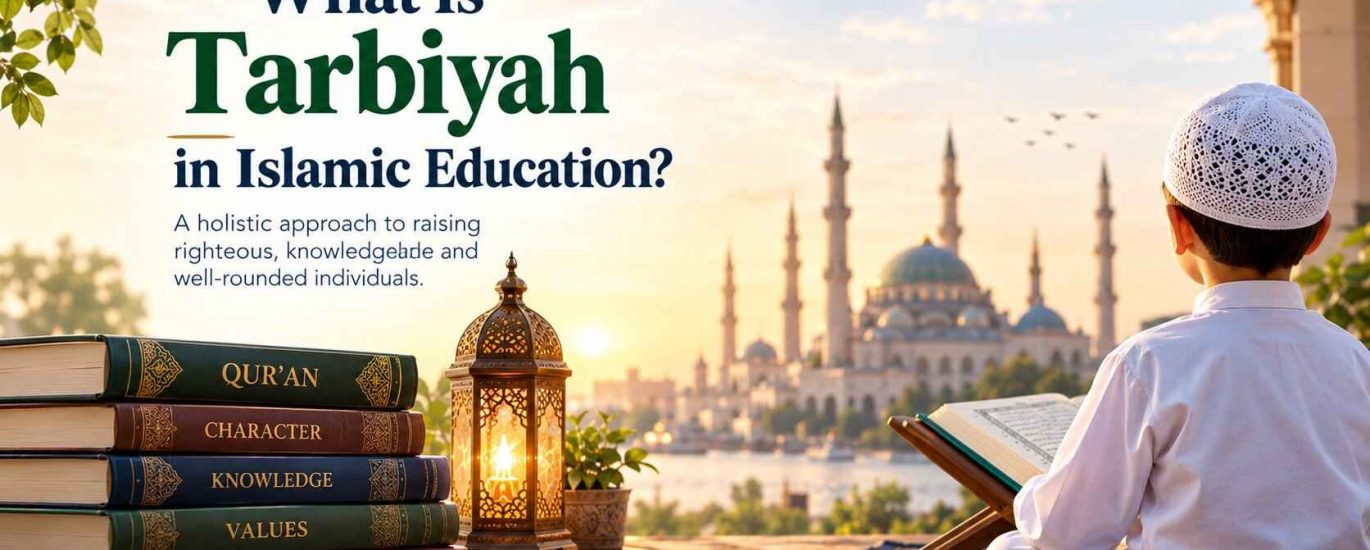
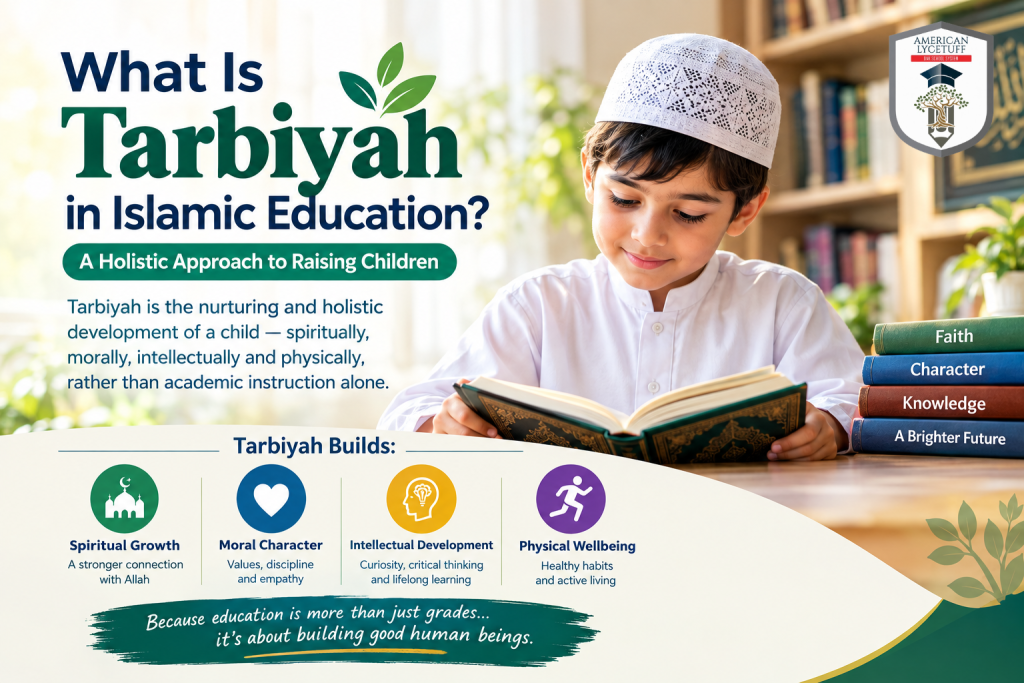
Tarbiyah is an Arabic word meaning nurturing, growth, and upbringing. In Islamic education, it refers to the holistic development of a child spiritual, moral, intellectual, and physical rather than academic instruction alone. It’s often contrasted with Talim (the transfer of knowledge and formal teaching), with the two seen as complementary: Talim fills the mind, while Tarbiyah shapes character.
Where the Word Comes From
Tarbiyah comes from the Arabic root “rabba,” meaning to nurture, cause to grow, or bring to completion. Classical scholars described it as a gradual process taking something (or someone) from one stage of development to the next, until it reaches its full potential. Applied to children, Tarbiyah is the deliberate, patient process of guiding a child toward becoming a complete person: someone grounded not just in knowledge, but in character, values, and faith.
Tarbiyah vs Talim: What’s the Difference?
This is one of the most common points of confusion, so it’s worth being precise:
- Talim refers to teaching and the transfer of knowledge facts, skills, subject matter. This is what a curriculum, a textbook, or a classroom lecture typically delivers.
- Tarbiyah refers to nurturing and holistic development instilling values, discipline, empathy, and spiritual awareness. This happens as much through modeling behavior and daily guidance as through formal lessons.
A simple way to think about it: Talim answers “what does a child know?” Tarbiyah answers “who is this child becoming?” Islamic education traditionally holds that both matter a child can be highly knowledgeable and still lack the character Tarbiyah is meant to build, which is why the two are treated as complementary rather than interchangeable.
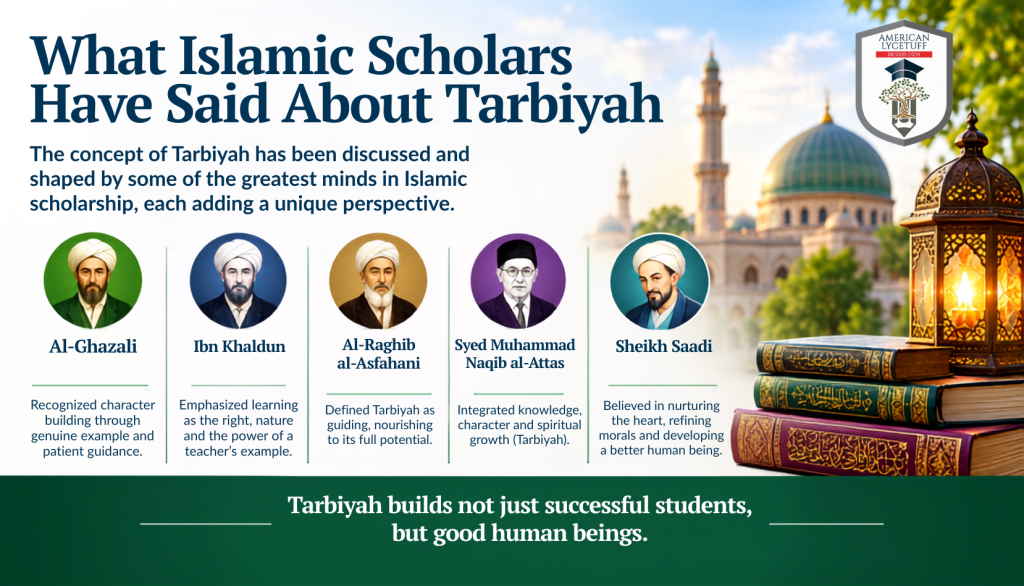
How Islamic Scholars Have Described Tarbiyah
The concept isn’t just a modern talking point it’s been examined by some of the most influential figures in Islamic scholarship, each adding a different layer to how it’s understood.
Al-Ghazali
Al-Ghazali, one of the most influential voices in Islamic educational thought, compared a child’s inner potential to a seed already present in the soil, waiting to be brought out through patient cultivation rather than forced growth. He described a child as a trust placed in the hands of parents and teachers, whose character could be shaped for better or worse depending on how seriously that trust was honored. For Al-Ghazali, correcting a child’s character mattered just as much as filling their mind with facts and he insisted this happen through gentle example rather than harsh correction, a principle reflected in how schools approach teacher training today.
Ibn Khaldun
Writing in his famous Muqaddimah, Ibn Khaldun focused on pacing education to a child’s actual stage of development moving from the whole picture down to detail, rather than overwhelming a young mind with complexity too soon. He also argued that a teacher’s own example shapes a student more powerfully than instruction alone, since children learn as much by imitation as by lesson.
Al-Raghib al-Asfahani
Al-Raghib al-Asfahani offered one of the most cited definitions of the word itself, describing Tarbiyah as the process of bringing something from one stage of development to the next until it reaches its full, intended potential. This framing is part of why Tarbiyah is understood as a gradual, ongoing process rather than a single lesson or event.
Syed Muhammad Naquib al-Attas
Not every scholar agrees on exactly how Tarbiyah fits into Islamic education. The Malaysian philosopher al-Attas argued that Tadib combining knowledge, instruction, and proper conduct together better captures the full aim of Islamic education, while Tarbiyah on its own leans more toward physical and moral development that can happen independently of intellectual and spiritual growth. It’s worth knowing this debate exists: even among experts, the exact boundaries between Tarbiyah, Talim, and Tadib are still discussed rather than fully settled.
Sheikh Saadi
The Persian poet moralist Sheikh Saadi devoted an entire chapter of his classic work, the Gulistan, to the effects of education, using short stories rather than formal argument to make his points a style that made his ideas about upbringing accessible far beyond scholarly circles for centuries afterward.
On timing and a child’s natural disposition
One story describes a nobleman’s son who simply couldn’t be taught, even by a skilled tutor, leading Saadi to reflect that instruction takes hold best in a nature already disposed to receive it comparing a poor character to iron that no amount of polishing can improve. For Saadi, good teaching worked with a child’s inherent disposition rather than against it, which is part of why he placed so much weight on starting early.
On discipline and its limits
His best-known image compares a child to a green branch easy to bend and shape while still young and supple, but nearly impossible to straighten once it has hardened with age. Elsewhere, though, Saadi tells a contrasting story of a harsh, bad-tempered schoolmaster whose cruelty toward his students eventually got him removed and replaced with a gentler, wiser teacher — a reminder that for Saadi, correction had real limits, and cruelty for its own sake did more harm than good. Scholars examining his work note that he treated punishment as a legitimate but last-resort tool, never a first response.
On listening before speaking
Saadi also wrote at length about the discipline of the tongue, advising that advice should only be offered once you’re confident it will actually be heard, and that interrupting others while they speak reveals more about a person’s own character than anything else.
Centuries later, Saadi’s stories remain some of the most widely read sources on moral upbringing across the Persian and broader Islamic world proof that Tarbiyah has long been taught as much through story and example as through formal instruction.
The Core Dimensions of Tarbiyah
Scholars generally describe Tarbiyah as covering several interconnected areas of a child’s development:
Spiritual Development
Building a child’s awareness of and connection to Allah understanding faith not as a set of rules to memorize, but as a lived relationship that shapes daily choices.
Moral and Character Development
Instilling honesty, compassion, patience, and accountability. This is less about lecturing a child on right and wrong, and more about consistent modeling and gentle correction over time.
Intellectual Development
While distinct from Talim, Tarbiyah still values knowledge but frames learning as a means toward wisdom and purposeful living, not knowledge for its own sake.
Physical and Emotional Development
Caring for a child’s physical wellbeing and emotional security is considered part of Tarbiyah too, since a child who feels unsafe or unwell struggles to grow in any other dimension which is part of why the earliest years, like Early Years schooling, place such heavy emphasis on a nurturing environment before academic pressure increases.
Why Tarbiyah Matters in Modern Education
In a world where school performance is often measured almost entirely by exam results and board rankings, Tarbiyah offers a useful counterbalance. It’s a reminder that raising a well-rounded person is a broader goal than producing a high scorer. This doesn’t mean academics don’t matter strong curricula like Matric and O Level remain essential for a child’s future opportunities but Tarbiyah argues that character, values, and spiritual grounding deserve equal, deliberate attention rather than being left to chance.
Who Is Responsible for a Child’s Tarbiyah?
Traditionally, Tarbiyah is understood as a shared responsibility between parents, teachers, and the wider community — not something outsourced entirely to school. Parents lay the foundation through daily example and guidance at home; schools reinforce and build on it through a structured, values-conscious environment often supported by dedicated student guidance and counselling and the broader community models it through everyday conduct. When these three are aligned, a child experiences Tarbiyah as something consistent, rather than a set of values taught in the classroom and contradicted everywhere else.
Frequently Asked Questions
What Does Tarbiyah Mean in Simple Terms?
Tarbiyah means nurturing or upbringing the holistic process of raising a child in every dimension of their development: spiritual, moral, intellectual, and physical, not just academic learning.
Is Tarbiyah the Same as Islamic Studies?
No. Islamic Studies (or Islamiyat) is typically a specific academic subject in a curriculum, covering religious knowledge as a subject to be taught (closer to Talim). Tarbiyah is broader — it’s the overall process of character and values formation that can happen both inside and outside a classroom, including through everyday behavior and guidance.
Can Tarbiyah Happen Outside of a Religious School?
Yes. While Tarbiyah has deep roots in Islamic tradition, its principles nurturing character alongside knowledge, values alongside academics can be woven into any school environment, regardless of whether the curriculum is religiously focused.
What’s the Difference Between Tarbiyah, Talim, and Tadib?
These three terms are related but distinct in Islamic educational thought: Talim refers to teaching and knowledge transfer, Tarbiyah refers to holistic nurturing and growth, and Tadib refers more specifically to refining conduct and manners (adab). Scholars differ on exactly how the three relate, but most agree they work together rather than in isolation.