Ask a child what they want to be when they grow up, and the answers are changing. Engineers, game designers, doctors, entrepreneurs, even people who build robots. Behind many of these careers are the same skills: curiosity, problem solving and the confidence to try things that might not work the first time.
That is the idea behind STEM and robotics education. This guide explains what they are, why they matter for children in Pakistan, and how to tell whether a school’s programme is the real thing.
Quick Answer
STEM stands for Science, Technology, Engineering and Mathematics. Instead of teaching these as separate subjects, STEM education connects them through hands-on projects. Robotics is a practical way to do this, because building and programming a robot needs all four. Good STEM education helps children think logically, work in teams and learn from mistakes, skills that employers are expected to value more in the years ahead.
What Is STEM Education?
STEM education is a way of learning where children use science, technology, engineering and maths together to solve real problems. A child might test which materials make a stronger bridge, measure and compare results, then redesign it. They are learning science (forces), maths (measurement), engineering (design) and technology (tools) in a single activity.
What makes it different from a traditional lesson:
- It is hands-on. Children build, test and improve.
- It is project-based. Learning is tied to a challenge, not just a chapter.
- It rewards trying again. A failed attempt is useful information.
- It is collaborative. Children usually work in teams.
Why STEM Matters for Children Today
The world of work is changing quickly. The World Economic Forum’s Future of Jobs Report 2025, as reported by Eco-Business, projects 170 million new roles and 92 million displaced jobs by 2030, a net increase of 78 million. It also says nearly 40 per cent of the skills required on the job are set to change. Technology skills in AI, big data and cybersecurity are expected to be the fastest growing, while analytical thinking, resilience, leadership and collaboration remain critical.
You do not need to turn your child into a programmer to benefit from this. The point is that the habits STEM builds, such as asking questions, breaking down problems and working with others, are useful in almost any career.
STEM also matters for fairness. A British Council Pakistan research paper on female participation in STEM subjects looks at why girls who study STEM subjects in high school often do not go on to study them at university. Starting early, with equal access for every child, is part of the answer. For a wider view of the subject, the British Council also publishes a needs analysis for STEM higher education in Pakistan.
What Is Robotics Education?
Robotics education teaches children to design, build and program robots. It is popular with parents because it makes abstract ideas visible: when a child’s code works, the robot moves, and when it does not, the child can see exactly where to look.
Through robotics, children typically practise:
- Problem solving: breaking a task into steps
- Coding and logic: giving clear instructions and finding errors
- Engineering thinking: designing, testing and improving
- Teamwork and communication: sharing roles and explaining ideas
- Resilience: debugging teaches children that mistakes are part of learning
What Does STEM Look Like at Different Ages?
Children do not need advanced equipment to begin. A sensible programme grows with the child:
- Younger children explore through building blocks, simple machines, story-based challenges and playful experiments.
- Middle years move to block-based coding, for example with Scratch, and simple electronics, solving defined challenges in teams.
- Older students use text-based programming such as Python, sensors and microcontrollers such as Arduino, and begin to link robotics with ideas such as automation and artificial intelligence.
At American Lycetuff DNK, our robotics programme follows this pattern in three stages: a Foundation stage for Primary and Middle Years, an Intermediate stage for Grades 6 to 8, and an Advanced stage for Grades 9 to O Level.
How to Tell if a School’s STEM Programme Is Real
Many schools use the word “STEM”. Here is how to check whether it means something:
- Ask what children actually build. Look for specific projects, not just a list of subjects.
- Ask how often. Is there regular, timetabled lab or project time, or only an occasional event?
- Ask who teaches it. Do teachers receive ongoing training in STEM methods?
- Ask to see the lab. Look at what children use and how they use it.
- Ask about progress. Does the programme grow from simple to advanced, or stay at the same level?
- Ask for examples. Photos, showcases, science fairs or competitions show whether the work is real.
- Ask about access. Does every child take part, or only a selected few?
STEM and Robotics at American Lycetuff DNK
At American Lycetuff DNK, STEM and robotics are part of how we teach. According to our STEM page, the programme is designed to build creativity, problem solving and innovation, with real-world, project-based learning instead of separate subjects. Activities include robotics workshops, coding challenges, engineering model design, prototype building, science fairs, innovation exhibitions and mathematics games.
In robotics, our pages describe a progression:
- Foundation: story-based robotics projects using LEGO Education or similar kits
- Intermediate: building and coding autonomous robots for set challenges, using tools such as Scratch or Arduino
- Advanced: programming with languages such as Python, C++ or the Arduino IDE, working with sensors and microcontrollers, and connecting robotics to artificial intelligence and automation ideas
We encourage students to take part in robotics challenges, science fairs and innovation competitions. Our teachers receive ongoing training through our teacher training programme, and we want every child to have access to STEM, regardless of gender or background.
[ADD REAL EXAMPLE: one specific project, competition or showcase from a campus, with a photo and the campus name. Delete this line if you do not have one.]
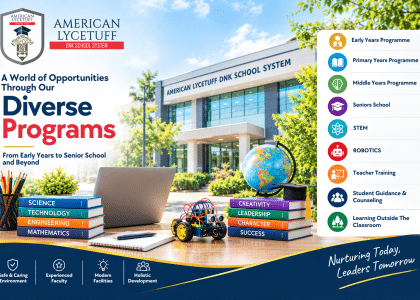
STEM works best alongside the rest of a child’s education. Our students also benefit from learning outside the classroom, student guidance and counselling, and character development through Tarbiyah. To see how all levels fit together, read our programmes guide.
How to Support STEM Learning at Home
You do not need expensive kits. Simple habits go a long way:
- Ask “why” and “how” questions during everyday activities such as cooking, building or fixing things
- Let your child build things from cardboard, blocks or household items, then test and improve them
- Try free coding games and block-based tools suited to your child’s age, such as Scratch, which is free to use online
- Count, measure and estimate together, for example while shopping or baking
- Praise effort and curiosity, not only correct answers
- Let them fail safely. A broken design is a chance to try again
Common Myths About STEM
“STEM is only for children who are already good at maths.” Not true. STEM builds maths confidence through practical problems.
“It needs expensive equipment.” Good STEM starts with curiosity. Equipment helps, but ideas matter more.
“It is only for boys.” Girls and boys both benefit from STEM, and starting early with equal access matters.
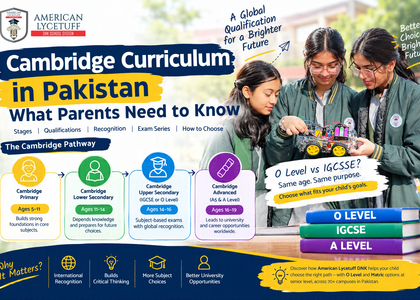
“It replaces strong academics.” The best programmes support core subjects. Students still need strong English, maths and science, whether they follow Matric or O Level. Our guide to the Cambridge curriculum in Pakistan explains how O Level fits in.
Frequently Asked Questions
What Is STEM Education in Simple Words?
STEM education teaches science, technology, engineering and maths together through hands-on projects, so children learn by building, testing and solving problems.
At What Age Can Children Start Robotics?
Children can begin with simple, play-based building and story-based activities at a young age, and move on to coding and electronics as they grow. The right starting point depends on the child and the school’s programme.
Do Children Need to Know Coding Before Starting?
No. Good programmes start with the basics and build up step by step.
Is STEM Education Useful if My Child Does Not Want to Be an Engineer?
Yes. The skills it builds, such as problem solving, teamwork and resilience, help in almost every career and in everyday life. career and in everyday life.
How Is STEM Different From Normal Science and Maths Classes?
Regular classes often teach subjects separately. STEM connects them through projects where children apply what they learn to solve a problem.
How Can I Check if a School Really Teaches STEM?
Ask what children build, how often, who teaches it, and whether you can see the lab and examples of student work.
Does American Lycetuff DNK Teach Robotics?
Yes. Our robotics programme runs in three stages, from Primary and Middle Years through Grades 6 to 8 and on to Grades 9 to O Level. Availability and activities can vary by campus, so please contact your nearest campus to confirm details.
Related Guides for Parents
- What is the right age to start school in Pakistan?
- School admission test preparation in Pakistan
- American Lycetuff DNK admissions open 2027-28
- Our school fee structure
- Best School in Lahore: a parent’s guide
- Top 10 Schools in Pakistan
Giving Your Child a Strong Start
STEM and robotics will not suit every child in the same way, but the habits they build, curiosity, logic and persistence, are worth having. If you would like to see our STEM and robotics learning for yourself, explore admissions or find your nearest campus to arrange a visit. You can also learn about each level on our Early Years, Primary Years, Middle Years and Senior School pages.