Ask a group of Pakistani parents about “Cambridge“, and you will hear it used for several different things: O Level, IGCSE, A Level, even a type of school. That confusion is understandable. The Cambridge curriculum is a full pathway of stages, and each one has its own name, age range and exams.
This guide explains how the Cambridge system works, how it is recognised in Pakistan, and how to decide whether it suits your child. It also shows how American Lycetuff DNK, with 70+ campuses across Pakistan, helps families choose between the O Level and Matric pathways at senior level.
Quick Answer
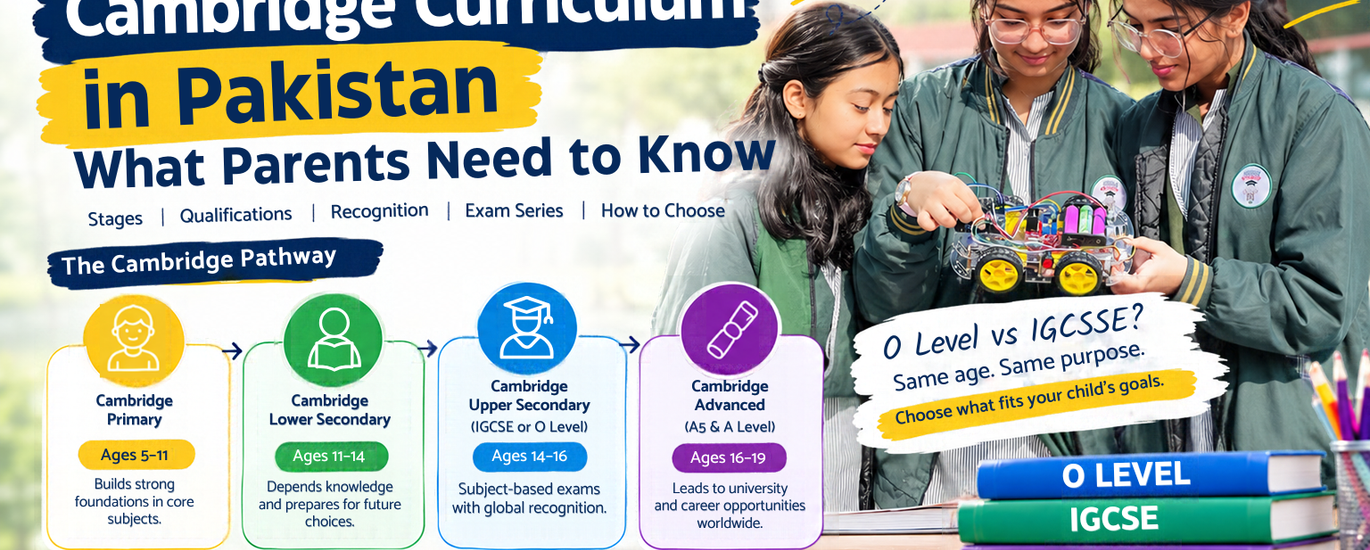
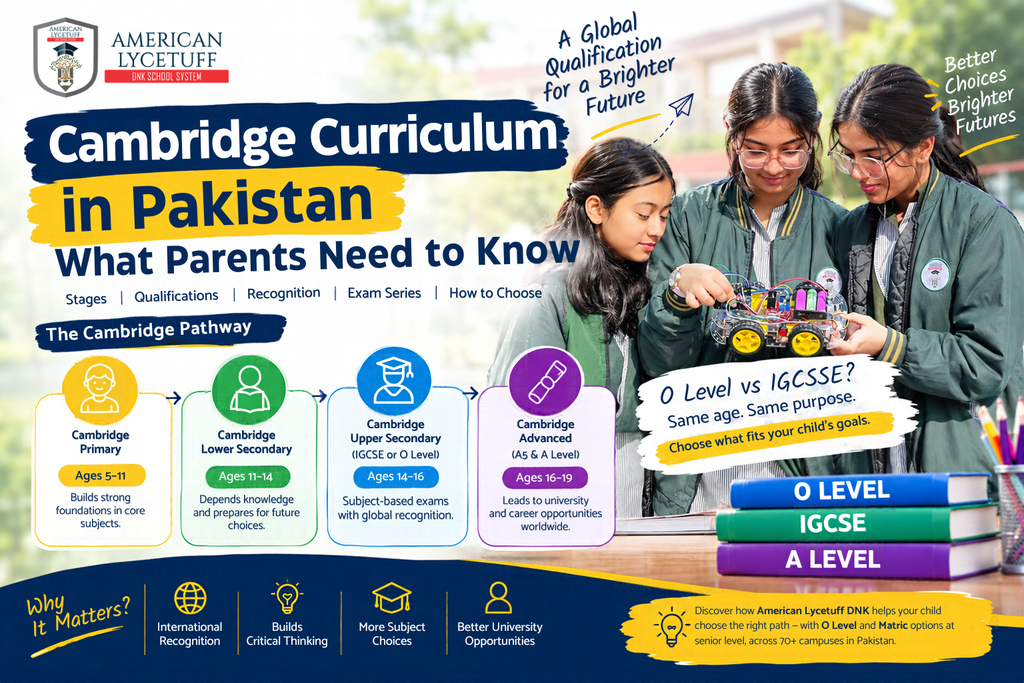
The Cambridge curriculum is an international education pathway run by Cambridge International Education. It runs from age 5 to 19 across four stages: Cambridge Primary, Lower Secondary, Upper Secondary (IGCSE or O Level), and Advanced (AS and A Level). In Pakistan, most families meet it at the Upper Secondary stage, where students take O Level or IGCSE exams instead of the local Matric board exams.
The Four Stages of the Cambridge Pathway
According to Cambridge’s own international prospectus, the pathway has four stages:
Cambridge Primary (ages 5–11)
This stage covers core subjects such as English, Maths and Science. Schools can use optional tests and a Primary Checkpoint at the end of the stage to track progress. It is a school-level programme rather than a public exam.
Cambridge Lower Secondary (ages 11–14)
This stage continues the same subjects at a deeper level and ends with an optional Lower Secondary Checkpoint. It prepares students for the choices they make at the next stage.
Cambridge Upper Secondary (ages 14–16)
This is where most Pakistani families focus. Students study for Cambridge IGCSE (70+ subjects, graded A* to G) or Cambridge O Level (40+ subjects, graded A* to E). Both are assessed through exams at the end of the course.
Cambridge Advanced (ages 16–19)
This stage includes AS Level and A Level (55+ subjects). A Level is graded A* to E and is widely used for university admission in Pakistan and abroad.
Not every school offers every stage. Many schools in Pakistan teach a mix, for example local primary and middle years followed by O Level at senior level. Always ask which stages a school actually runs.
O Level vs IGCSE: Is There a Difference?
Both are Cambridge qualifications taken at around the same age. The practical points for parents:
- Subject range: IGCSE offers more subjects; O Level offers fewer.
- Grading: IGCSE is graded A* to G; O Level is graded A* to E.
- Recognition in Pakistan: Cambridge states that the Inter Board Committee of Chairmen (IBCC) gives the same equivalence to Cambridge IGCSE as to Cambridge O Level.
So for most families, the choice between the two matters less than the quality of teaching and the subjects the school can offer.
How Cambridge Qualifications Are Recognised in Pakistan
Equivalence for foreign qualifications in Pakistan is handled by the Inter Boards Coordination Commission (IBCC), a national body under the Ministry of Federal Education and Professional Training. Its site lists O and A Levels under “British System” equivalence. If your child studies O Level or A Level, they will usually need an IBCC equivalence certificate for admission to local universities and colleges and for some official processes.
According to Cambridge’s Destination Pakistan brochure, IBCC treats Cambridge IGCSE and O Level as equivalent to the Secondary School Certificate (SSC), and A Level as equivalent to the Higher Secondary School Certificate (HSSC), provided the SSC-level requirements are met. The same brochure reports over 800 Cambridge schools in Pakistan (2025 figure). Equivalence does not guarantee admission, because each university sets its own criteria.
Requirements and subject rules can change, so check the IBCC website and your target university’s admission page before your child chooses subjects. Do not rely on a school’s word alone for a decision that affects admission.
How Cambridge Exams Work
Cambridge runs its main exam series in June and November each year. In 2026, for example, Cambridge listed June results for AS and A Level on 11 August and for IGCSE and O Level on 18 August, according to its 2026 calendar. Exact dates change each year, and availability can differ by country, so confirm the current series and registration deadlines with your school.
Key differences from the local board system:
- Students usually choose subjects individually rather than fixed groups.
- Exams are set and marked internationally, with a strong focus on understanding and application.
- Students can often sit papers across different series, depending on the school and subject.
- Students register through an approved exam centre, often through their school.
Cambridge vs Matric: A Short Comparison
The two systems suit different goals. Cambridge offers more subject flexibility and international recognition. Matric follows the local board path, run by boards such as BISE Lahore or the Federal Board (FBISE), and is more closely tied to the national intermediate system. Costs, exam fees and university routes also differ. For a full side-by-side comparison, read our guide on Matric vs O Level.
Who Is Cambridge Best For?
Cambridge often suits families who:
- are considering university study abroad
- want a child to choose subjects based on strengths instead of a fixed group
- value English-language instruction and written, analytical exams
- are comfortable planning around exam series, registration and extra fees
It may suit some children less well if they struggle with exam-style writing in English, or if the family’s plan is a direct path into the local intermediate system. Neither route is “better” for every child. It depends on your child’s strengths and your family’s plans.
Questions to Ask a School About Cambridge
Before you enroll, ask:
- Which Cambridge stages does the school actually teach (Primary, Lower Secondary, O Level, IGCSE, A Level)?
- Is the school an approved Cambridge centre, or do students sit exams through another centre?
- Which O Level or IGCSE subjects are offered, and how many students take each?
- What are the total costs, including registration, exam fees and any extra classes?
- How does the school support students who want to switch between Matric and O Level?
- How are teachers trained and supported for Cambridge syllabuses?
O Level and Matric at American Lycetuff DNK
If you are weighing Cambridge against the local board, American Lycetuff DNK gives you both options under one roof. Our Senior School offers Matric and O Level pathways, so you do not have to commit to one system before choosing a school, and a change of direction does not mean changing schools.
Why Parents Consider American Lycetuff DNK for the O Level Route
- Two pathways, one school. Matric and O Level are both available at senior level, so students can follow the route that fits their goals.
- Guidance when it matters. Our student guidance and counselling team helps students and parents choose subjects and pathways as children move through the grades.
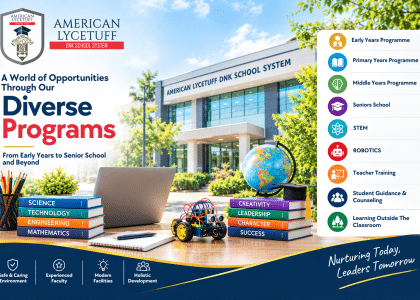
- A foundation that starts early. Our Early Years, Primary Years and Middle Years programmes build the English, Maths and Science skills that senior exams rely on.
- Hands-on learning. STEM and robotics are part of the curriculum, not optional extras.
- Trained teachers. Our teacher training programme supports teachers with ongoing development.
- Character alongside academics. Tarbiyah is part of how we teach, so exam results are not the only goal.
- A national network. With 70+ campuses across Pakistan, including Islamabad, Lahore, Karachi and Quetta, the same academic framework can follow your family if you relocate.
Plan Your Child’s Pathway With Us
Every family’s situation is different. Our team can walk you through the options for your child’s grade, and our fee structure shows what to expect before you apply. Availability of O Level and subject options can vary by campus, so please contact your nearest campus to confirm current details. You can also see how all our levels fit together in our programmes guide.
Frequently Asked Questions
What Is the Cambridge Curriculum in Simple Terms?
It is an international education pathway for ages 5 to 19, run by Cambridge International Education. It has four stages: Primary, Lower Secondary, Upper Secondary (IGCSE or O Level) and Advanced (AS and A Level).
Is O Level the Same as Cambridge?
O Level is one Cambridge qualification, taken at the Upper Secondary stage. “Cambridge” is the wider system that also includes IGCSE, AS Level, A Level and earlier stages.
Is IGCSE Equal to O Level in Pakistan?
Cambridge states that the IBCC gives the same equivalence to Cambridge IGCSE as to Cambridge O Level. Check the IBCC website for current rules before applying to a university.
Does American Lycetuff DNK Offer O Level?
Yes. American Lycetuff DNK offers both Matric and O Level pathways at senior level, so families can choose the route that fits their child. Availability can vary by campus, so confirm current options with your nearest campus through our contact page.
Making the Right Choice
The Cambridge curriculum is a strong option for many Pakistani families, but the “right” system is the one that fits your child’s strengths, your budget and your plans after school. Talk to the school, ask for real examples of subject choices and results, and check recognition rules with the IBCC and your target universities. At American Lycetuff DNK, our counsellors and teachers can help you compare the O Level and Matric routes for your child’s strengths and goals. If you would like to discuss the options, explore admissions or find your nearest campus to arrange a visit.