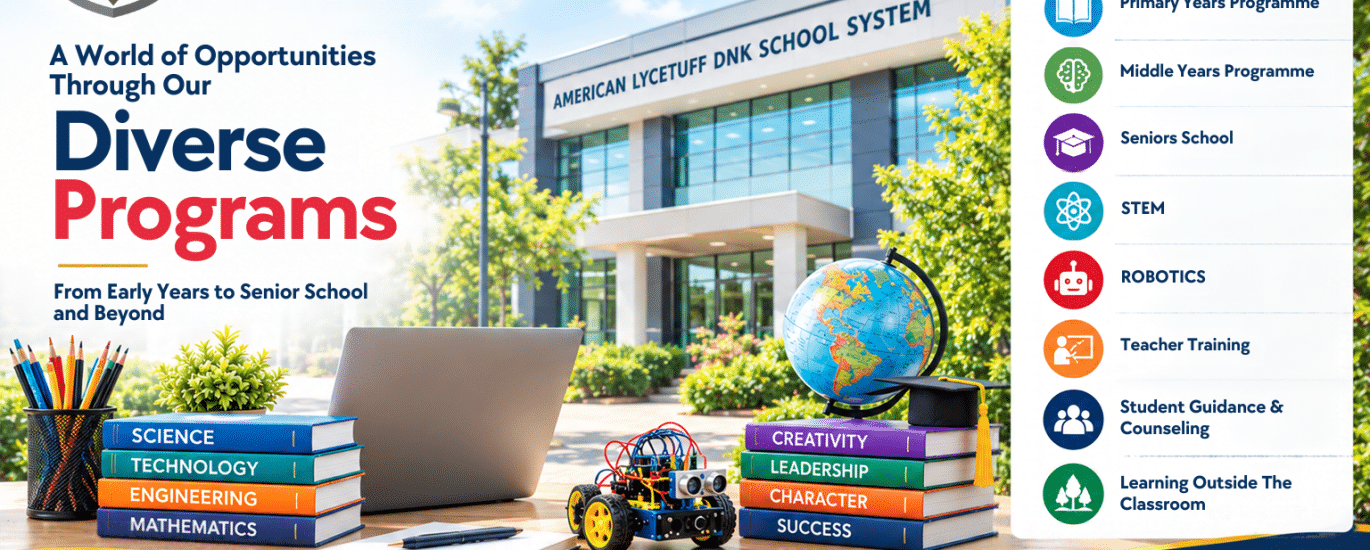
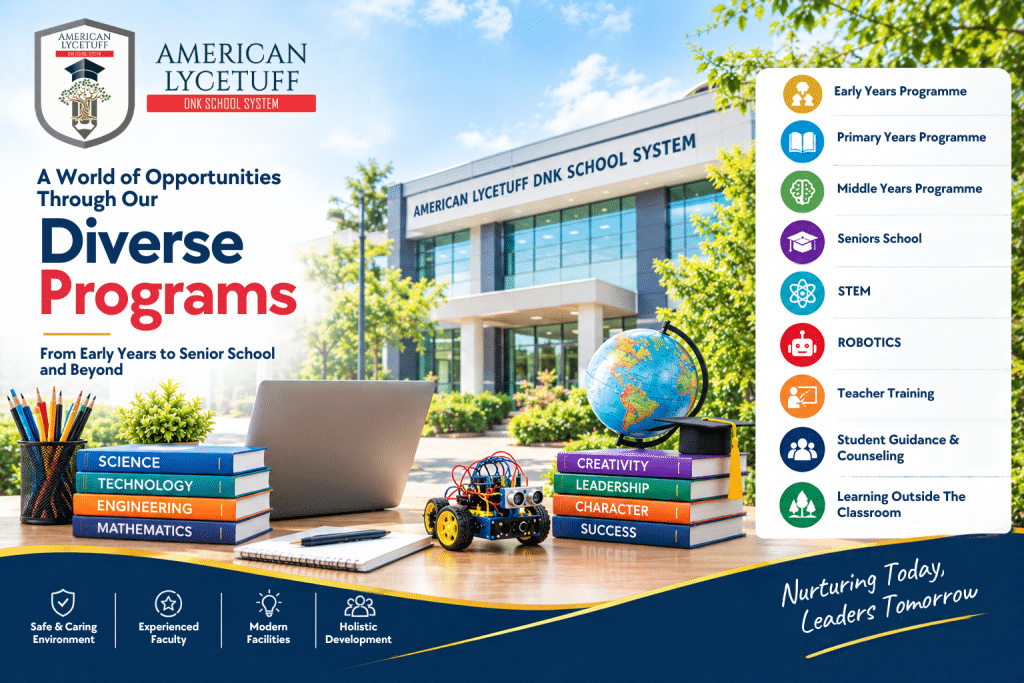
Choosing a school often means piecing together information from several different pages: one for academics, another for extracurriculars, another for support services. Parents end up opening tab after tab, trying to build a complete picture from fragments. This guide takes a different approach. It brings every one of the American Lycetuff DNK programs into one place, covering a child’s full journey from their first year through to Senior School, so the full picture is available in a single read.
Academic Programs by Age Group
A child’s academic path isn’t one fixed experience. It changes shape at every stage, and what works for a five-year-old would be entirely wrong for a fifteen-year-old. Here’s how each stage is structured.
Early Years Programme
The starting point for a child’s education, covering playgroup through kindergarten. At this age, the goal isn’t to rush academic content. It’s to build curiosity, social confidence, and comfort with a structured environment away from home. Children at this stage learn through play, stories, and guided activity rather than formal instruction, and the habits formed here, listening, sharing, following simple routines, become the foundation everything else is built on. Read more on the Early Years Programme page.
Primary Years Programme
Covering Grades 1 to 5, Primary Years is where academic learning becomes more structured. Core subjects like Mathematics, English, Science, and Urdu are introduced through interactive methods rather than rote repetition, with an emphasis on helping students understand concepts rather than just memorize facts. This stage also introduces the first real sense of academic routine: homework, regular assessment, and a growing sense of responsibility for one’s own learning. Read more on the Primary Years Programme page.
Middle Years Programme
Covering Matric and O Level pathways, Senior School is where everything built in the earlier stages gets put to use. Both curriculum tracks are offered under one roof, which matters more than it might seem. Families don’t need to choose a different school if a student’s curriculum needs change, and switching pathways doesn’t mean starting over somewhere new. If you’re deciding between the two, our Matric vs O Level comparison breaks down the cost, structure, and university pathway differences between them. Read more on the Seniors School page.
Seniors School
Covering Matric and O Level pathways, Senior School is where everything built in the earlier stages gets put to use. Both curriculum tracks are offered under one roof, which matters more than it might seem. Families don’t need to choose a different school if a student’s curriculum needs change, and switching pathways doesn’t mean starting over somewhere new. If you’re deciding between the two, our Matric vs O Level comparison breaks down the cost, structure, and university pathway differences between them. Read more on the Seniors School page.
Beyond the Standard Curriculum
Academics are only part of what shapes a student. These programs run alongside the core curriculum rather than replacing it, and they’re part of regular school life, not optional extras reserved for a few.
STEM
Science, technology, engineering, and mathematics are built into the core curriculum rather than offered as an occasional elective. Instead of learning science purely from a textbook, students get hands-on exposure to experiments, applied problem-solving, and real tools from an early age. This matters because STEM skills, logical reasoning, comfort with technology, structured problem-solving, carry over into subjects well beyond science itself, shaping how students approach challenges across the board. Read more on the STEM page.
Robotics
Working alongside the STEM program, robotics gives students practical experience building and programming. Students move from following instructions to designing their own solutions, developing patience and logical thinking along the way, skills that extend well beyond any single robotics session. For students who go on to pursue technology or engineering fields later, this kind of early, hands-on exposure often becomes a genuine head start rather than a one-off activity they barely remember. Read more on the Robotics page.
Learning Outside The Classroom
Education isn’t confined to a desk. This program covers trips, hands-on activities, and real-world experiences designed to connect classroom learning to life outside school. A lesson about ecosystems means more after a field trip than it does from a diagram alone, and a lesson about teamwork sticks better after an actual group activity than it does from a definition on a whiteboard. This program exists because some of the most lasting lessons happen outside the four walls of a classroom entirely. Read more on the Learning Outside The Classroom page.
Support Systems Behind the Classroom
None of the programs above work in isolation. They depend on the people delivering them and the support available when a student needs more than just a lesson plan.
Teacher Training
A school is only as strong as its teaching staff, and that strength doesn’t happen by accident. Our teacher training program is ongoing and structured, not a one-time orientation delivered once and forgotten. Teachers continue developing both their subject knowledge and their classroom methods throughout their careers here, which shows up directly in how lessons are taught day to day, not just in a credential on paper. Read more on the Teacher Training page.
Student Guidance & Counselling
Academic and personal support go hand in hand, and treating them as separate issues rarely serves a student well. Our counselling team works with students on subject and pathway decisions, the kind of choices covered in our Matric vs O Level and group-selection guides, as well as personal challenges that can quietly affect a student’s learning long before a parent or teacher notices. The goal is simple: no student should be navigating a difficult moment entirely alone. Read more on the Student Guidance & Counselling page.
How It All Fits Together
These programs aren’t separate tracks running in isolation from each other. A student moves through Early Years, Primary, and Middle Years with STEM, robotics, and learning-outside-the-classroom experiences woven throughout the whole way, not bolted on as afterthoughts. Trained teachers deliver the academic content, while a counselling team follows a student’s progress and wellbeing alongside it. By the time a student reaches Senior School and has to choose between Matric and O Level, they’ve already built the academic habits, technical exposure, and personal support network to make that choice with real confidence, not for the first time under pressure.
If you’d like a sense of what this looks like on an ordinary day rather than as a list of programs, our article on a day in the life of a student walks through a typical school day from morning arrival to dismissal.
Frequently Asked Questions
What Age Groups Does American Lycetuff DNK Serve?
Programs run from playgroup-age Early Years through Senior School, covering the full span of a child’s schooling through to Matric or O Level completion.
Is STEM Available at Every Grade Level?
STEM and robotics are built into the curriculum across grade levels, with the specific focus, complexity, and tools adjusted to suit each age group rather than offered as a one-size-fits-all program.
What Kind of Support Is Available Beyond Academics?
Our Student Guidance & Counselling team supports both academic decisions, like subject and pathway choices, and personal challenges that can affect a student’s wellbeing and ability to focus on learning.
Can a Student Move Between Matric and O Level?
Since both are offered under one roof at the Senior School level, families don’t need to change schools to switch curriculum tracks, though timing matters and earlier is generally easier than later. Our Matric vs O Level guide covers this in more detail.
How Do These Programs Prepare a Student for Senior School?
Each stage builds toward the next. Early Years builds foundational habits, Primary Years builds core academic skills, and Middle Years develops the critical thinking and subject exposure that make choosing a Senior School pathway, and succeeding in it, far more manageable.
Explore Further
Each program page linked throughout this guide goes into more depth than a single overview article can cover. If you’d like to see any of these in person rather than read about them, you can explore admissions or find your nearest campus to arrange a visit.