
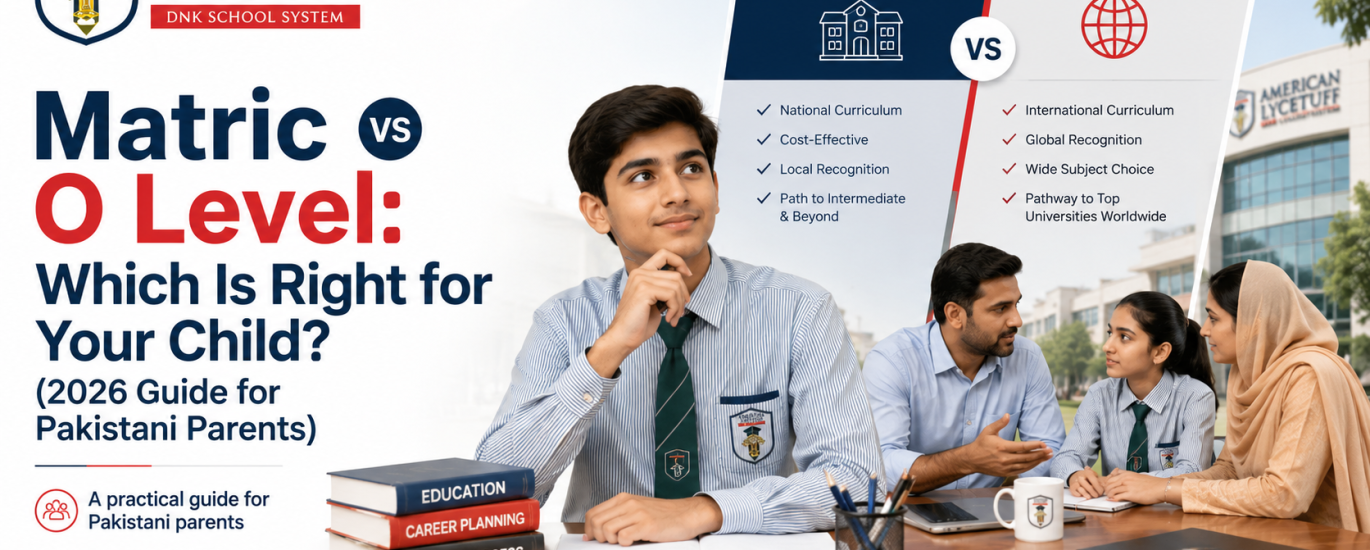
For parents in Pakistan, few decisions cause as much back and forth as choosing between Matric and O Level for their child’s secondary education. Both lead to respected qualifications, but they follow different systems and the “right” choice really depends on your child’s strengths and your family’s long-term goals.
Here’s a clear, no-nonsense comparison to help you decide.
Quick Answer
If your priority is affordability, a system built around local university admissions, and a familiar structure most Pakistani households have grown up with, Matric usually works better. If your priority is international recognition, subject by subject flexibility, and eventually studying abroad, O Level tends to be the stronger fit. Many strong students do well in either the difference lies more in learning style and future plans than in one system being objectively “harder” or “easier.”
What Is Matric?
Matriculation (Matric), formally the Secondary School Certificate (SSC), is administered by Pakistan’s provincial Boards of Intermediate and Secondary Education (BISE). It covers Grade 9 and Grade 10, with a board exam at the end of Grade 10.
Students typically choose a “group” early on Science, Arts/Humanities, or Computer Science and study a fixed set of subjects within that group rather than picking individual subjects freely.
Why families choose Matric:
- Lower overall cost compared to Cambridge registration and exam fees
- Direct, well understood pathway into Pakistani intermediate colleges (FSc, FA, ICS) and local universities
- Familiar structure most extended family and community members have gone through the same system
- No equivalence certificate needed when applying to local institutions
What Is O Level?
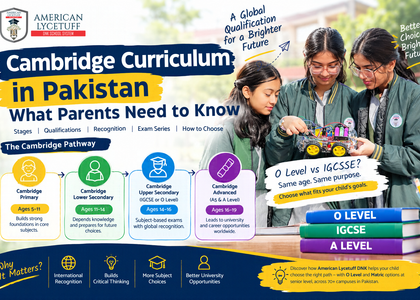
O Level (Ordinary Level) is part of the Cambridge International Education system, run by Cambridge Assessment International Education (UK). Instead of fixed subject groups, students select individual subjects and sit exams for each one separately, usually across Grade 9 to 11, with exam sessions offered twice a year (May/June and October/November).
Why families choose O Level:
- Internationally recognized qualification, useful if studying abroad is a future possibility
- Flexibility to pick subjects based on individual strengths rather than a fixed group
- Can retake individual subjects without repeating the whole exam
- Widely regarded as strong preparation for A Levels and university style independent study

Matric vs O Level: Side-by-Side Comparison
| Factor | Matric | O Level |
| Exam Board | Provincial BISE boards | Cambridge International (UK) |
| Subject Structure | Fixed groups (Science/Arts/Computer) | Individual subject choice |
| Exam Frequency | Once a year | Twice a year (May/June, Oct/Nov) |
| Local University Recognition | Direct, no equivalence needed | Needs IBCC equivalence certificate |
| International Recognition | Limited | Strong, widely recognized abroad |
| Typical Cost | Lower | Higher (registration + per-subject fees) |
| Retake Flexibility | Limited, often full-year repeat | Subject-by-subject retakes |
| Common Next Step | FSc / FA / ICS (Intermediate) | A Level |
Which Is Better for Specific Goals?
Aiming for medical or engineering in Pakistan (MDCAT/ECAT): Both pathways work, and a strong grounding in STEM subjects from an earlier grade helps either way. Matric students move directly into FSc Pre-Medical or Pre-Engineering. O Level students can pursue A Levels or FSc equivalency, but will need an IBCC equivalence certificate to apply to Pakistani public universities and medical colleges worth planning for early rather than discovering it late.
Planning to study abroad: O Level (followed by A Level) is generally the smoother path, since it’s recognized by universities worldwide without a separate equivalence process.
Budget-conscious families: Matric is typically the more affordable route, since it avoids Cambridge registration and per-subject exam fees.
Students with uneven strengths (for example, strong in Math and Science but weaker in a particular language): O Level’s subject-by-subject structure allows more tailoring, since students aren’t locked into one fixed group.
Frequently Asked Questions
Is O Level harder than Matric?
Not inherently — the two systems test differently rather than one being objectively harder. O Level often emphasizes analytical and applied understanding, while Matric follows a more structured, syllabus-based approach. Which one feels “harder” usually comes down to a student’s learning style.
Can O Level students apply to Pakistani medical colleges?
Yes, but they’ll need an equivalence certificate from the Inter Boards Coordination Commission (IBCC) to convert O Level (and later A Level) results into an equivalent Pakistani grading system before applying
Is Matric equivalent to O Level?
They’re treated as broadly equivalent for admission purposes within Pakistan, but they aren’t identical — grading systems, subject structures, and international recognition all differ.
Which is more expensive, Matric or O Level?
O Level generally costs more, mainly due to Cambridge registration and per-subject examination fees charged on top of school tuition.
Can a student switch from Matric to O Level later, or vice versa?
It’s possible, but easiest before Grade 9 starts ideally while a child is still in the Middle Years Programme. Switching mid-way is harder since the two systems structure subjects and timelines differently.
Making the Right Choice for Your Child
There’s no universally “better” system only what fits your child’s strengths, your family’s plans, and where you see them heading after school. Some families choose a school specifically because it offers both pathways under one roof, so the curriculum decision doesn’t have to double as a school-switching decision.
At American Lycetuff DNK Senior School, students can pursue either Matric or O Level, with guidance from the school’s Student Guidance & Counselling team to help match the right pathway to each child’s strengths. If you’re weighing this decision for your own child, explore admissions or find your nearest campus to talk it through.


A very helpful comparison for parents! Understanding the differences between Matric and O Level makes choosing the right path much easier.